Plants are so resilient!!!! These guys are going to be just fine, even after a long car ride.
Plants never cease to amaze me with their enthusiasm for life!
But here is a pro tip I just learned today: If you bring tomato plants to your plant-loving mother’s house, be prepared for her to keep them for herself! She has already claimed them for her own, because she’s a cheeky devil!
It’s hard to blame her – they’re so happy and healthy!
I’ll fight her if she tries to keep the mirliton, however. Lol!
Like champions, these green guys survived the 8+ hour car ride!
They’re a little beat up and need some TLC but they’re going to be just fine, I believe.
The tomatoes are still producing despite not even being planted anymore! Silly plants!
I harvested six tomatoes yesterday after arriving!
Here’s what everyone looked like after the long car ride:
When I was sitting in that empty apartment, it was hard to focus on happy emotions or even hopeful ones. But the last few weeks have been overwhelmingly hopeful and optimistic.
I think we as people have a hard time seeing past obstacles when they’re right in front of us. That night, I was faced with feelings of loss. But now that there’s a little air in between that night and today, I can look back and see other factors were at play. For example, there was a train that derailed on the New Mexico/Arizona border…so if I’d left on my drive that day, I would’ve run into closed highways and lengthy detours. Because I stayed, my good friend Liz was able to alert me about the accident and I was able to successfully find an alternative route Sunday morning, bypassing what could’ve been hours of delay.
So was my sadness all for naught? No, I think it’s important to acknowledge our emotions for the purposes they serve.
Also, years ago when I was fresh out of college, I remember being terrified to move out of Indiana, the place where I was raised. But I made a decision to acknowledge the fear but not let it stop me from moving forward. Fear is valid but not a good enough reason not to do something. So I left Indiana, but I’ve never left that decision to face my fears – I’ve carried that with me to present day.
All of that to say, despite being sad, and fearful and feeling a little lost, I was going to go forward no matter what.
And now here I am, in the Land of Enchantment, which I love. Back with friends and family who I love.
I start the new job on Wednesday. I don’t regret the work I did for a global corporation but it definitely feels more in line with my values to work for this local Albuquerque company and invest in my beloved community. I’ve always had a strong work ethic (thank you, Indiana) so now instead of working hard for a company that doesn’t appreciate it, I’ll funnel that work to a company that values me for my skills and knowledge. Hopefully we’ll all grow together and have a positive impact on the city.
I’ll keep you posted! Thank you for reading, and for your continued support!!!
I’m sitting in an empty apartment, my belongings on a truck going who knows where. My new casita won’t be ready for a week or two, so my stuff will sit somewhere in limbo, maybe in Phoenix, maybe in Albuquerque.
I’m sitting in limbo, too, temporarily tethered to Phoenix. I find myself filled with emotions as I wait for the wee hours of the morning to start my drive east.
I dislike driving at night. I know lots of people prefer to travel at night, when the roads are less crowded. But for me the darkness signals increased dangers and decreased views. I like to see when I drive. I want to see the mountains and the birds and dusty houses along the desert highways.
In the hours before the sun rises, though, the darkness begins to lift and that’s my favorite time to drive. Get a couple of hours under my belt and then when the sun peeks over the horizon, I’m rejuvenated for the rest of the drive.
That’s my plan. But first I need to face these emotions. It felt natural to me, familiar, to write about them, as writing is my therapy, my best tool for disarming the negative emotions.
I’ll start with sadness. For sure, I’m sad. The sadness is amplified by the empty apartment I’m sitting in. Arizona has been good to me. I’ve met lovely people. I’ve been here nine years.
There’s doubt. Is doubt an emotion? I guess doubt would be a reflection of the fear of not knowing if I’m making the right decision or not. That same fear sparks anxiety and worry, too. Disappointment is in there as well.
There’s a part of me that’s grieving. For the life that could’ve been, but wasn’t. The life that was good, but not great. The life that carried a footnote that wondered if I tried hard enough.
But I did try. I came to Phoenix to improve my life and I did that. I learned, I grew, I experienced, I loved. In the end, Arizona is just not the right place for me. I never quite jelled with it. Sure, I like Arizona, and it’s really beautiful. But it never captured my heart the way I expected it to.
I’ve come to believe that’s because my heart never stopped loving New Mexico. Even now when I think about it, I get a little tug on the heartstrings. That’s when I know I’m moving in the right direction.
So to New Mexico I go, sometime in the early morning hours.
What awaits me? Mom, for one. My cousin Jenny, too. Hopefully lots of friendships that I can pick up where we left off. A killer job. A cute little casita. And endless possibilities.
I know what you’re wondering. You’re plant people – you’re wondering what I’m going to do with the mirliton, aren’t you? Billy, I’m looking at you! Lol! That’s the content you showed up for, not a dive into my feelings, haha!
So the short answer is, I’m bringing it with me. The bigger issue of will it survive we’re going to put to the side for now because of course I have no idea if it will or not.
Right now, it’s sitting in my car. Along with the tomatoes and the garlic. Yes, my car smells great right now!
Lemme walk you through my thought process. First, let me preface this by saying that the idea of moving back to New Mexico is less than a month old, so when I planted my vegetable garden, the thought of moving away wasn’t even a blip on the radar.
So here’s how the garden looked yesterday:
Healthy plants. Garlic, two cherry tomato plants and the mirliton (chayote squash) on the right.
You can see the mirliton growing outward not up toward the trellis.
I normally would see that and move the vine back to the trellis so it could grow up. But I knew that tomato cage wasn’t coming with me because it wouldn’t fit in my Toyota Camry.
I knew in advance I was going to have to cut these cute little telephone cords!!!
So hard to do! But necessary!
Now you may ask why on earth would I take tomatoes with me when I could just buy more when I get to Albuquerque? This is why:
And because no plants left behind!
Now the garlic was troubling because I planted it back in October but it won’t be ready until after Memorial Day. I called my good friend Judie to ask if she’d ever transplanted garlic before. Of course she hadn’t – no one in their right minds rips garlic out early. I asked her if she thought it would work and she said, “They’re not going to like it,” which is one thousand percent true but not necessarily a deal breaker for me. None of the plants will enjoy this move.
In the spirit of “try it and see,” I decided to try moving all of them with me. (Actually with me, as movers won’t take them across state lines plus I don’t want them on a truck.)
I tried both of these big pots in the back seat to make sure they’d fit (they do).
The tomatoes are already too tall for planting in a container that big and still fitting in the car, so the plan with them is to place them in the bottom of the pot for the drive, then plant them when I get to Mom’s.
The mirliton will likely live in a container for a long time (the new casita has a patio but I don’t think any beds), so I decided to go ahead and plant it. Since it’s a short plant, it’ll fit in the car easily.
Look at all those healthy roots! And the husk from the original squash!
I’m so proud of how much that mirliton has grown!
Here are all the plants, immediately after pulling them out:
So far so good!
You can see how I simply put the tomatoes and garlic inside that container without planting them. Now there is a little soil at the bottom to help keep the roots moist on the drive but they’re not planted in that red container.
Later on in the day, the mirliton had taken a turn for the worse:
Womp, womp! Sad, but hardly surprising. I just ripped it out of the only home its ever known.
This morning, signs of life!
Woohoo!
I loaded all the plants in the back seat of the car this morning, thinking we’d be on our way. When the movers took the whole day, I kept hoping they would be ok. I left them in place and will hope for the best.
So that’s the end of my story for now. I’m still sitting in an empty apartment, in limbo, but my mood has improved greatly thinking about what New Mexico has in store for me.
We’ve got major progress on the “miracle mirliton” as my cousin Bill, one of my favorite people on the planet, recently called it. His description brought a smile to my face. His enthusiasm reminded me to update all of you.
I’ve been getting the biggest kick out of watching new leaves popping out almost daily but I haven’t shared that with you yet.
The mirliton that I bought from Louisiana is growing like crazy. It’s been warm in Phoenix and believe it or not, we’ve had a lot of rain recently. So the conditions are great for growing. I’m excited because this is the chayote squash I’ve been wanting for years. If I can be successful, I’d be over the moon.
There have been a few tendrils but none of them have reached the cage until today.
This little guy made it! And he’s got a friend right behind him!
For the kids out there, this is what a telephone cord looked like back when we were tethered to our phones in a different way, haha!
Am I the only one who thinks tendrils are about the most charming things you’ve ever seen?
The mirliton is in a south-facing patio bed that I built a few years ago. Here’s what it looks like today:
The mirliton is on the right, and there are two cherry tomato plants in the center. I planted those a few weeks ago, which is a little late, but they have a 65-day maturity time so they should be ripe before it gets too hot here.
In Phoenix, the summer months are way too hot for tomatoes. You can keep the plants green but they won’t produce. If you plant in the spring, you have to choose varieties with short harvest times. If you plant tomatoes in the fall, you also have to choose varieties with short harvest times so they will ripen before it gets too cold for them. For me personally, I don’t bother trying to grow large tomatoes – I stick to cherry tomatoes, yellow pears, orange sunbursts, etc.
Also in the bed is garlic that I planted in October, along with some winter flowers, lobelia and pansies. Before I planted the mirliton and tomatoes, the bed was full of garlic and flowers, including some monster-sized dianthus. I moved most of the flowers elsewhere but kept a few in the corner because I love looking at them so much.
As you can probably tell, I’m thrilled with the progress of the squash. New growth is always so hopeful and rejuvenating.
With that, I’ll leave you to your day and hope that it’s bright and full of growth.
When I first started writing this blog, way back in 2009, I had a small plant care business in Albuquerque, New Mexico called Good To Grow.
You know how when you go to the bank or the doctor’s office, and they have plants in the lobby? My job was to care for those plants. My clients included mortgage companies and real estate firms, a cereal factory, a tv station, many restaurants, a few bars, a cancer hospital, insurance companies, a phone company, a car dealership, dental offices, and several private residences. I was all over the city for 14 years (2001 – 2015) visiting those offices and homes, maintaining the health of their green investment. I was also responsible for the business end, like invoicing, bill paying, taxes, etc.
I loved it.
I started this blog as my way of showing people not only how to care for houseplants but also to fall in love with them like I had.
Plants can’t speak English, or bark or meow, but they’re living, breathing creatures. Houseplants are a piece of Nature in your home. They should be pampered like pets.
If you have plants in your home, they’re 100% dependent on your care, as they can’t walk to the sink and water themselves. My goal was to help people welcome these wonderful green pets into their home and make them part of the family. That remains one of my goals to this day.
Fast forward to 2024. I live in Phoenix, Arizona now, and I still work with plants but in a much different way.
These days, I work for Marriott, at a luxury JW Marriott property. I run the chef’s garden there, growing vegetables, fruits, herbs and flowers for the chefs, bakers and bartenders.
I thought I’d share some photos with you.
Believe me, it didn’t always look this good. Here’s what it looked like when I agreed to take on the job:
Oof! Not good! Previously to me, there hadn’t been a lot of effort put into the development or maintenance of the garden. But the garden did have bones, so there was something for me to work with, even if it wasn’t much.
I definitely had my work cut out for me, but if you’ve ever met me, you know that I have never shied away from hard work in my life.
So I rolled up my sleeves and got to work.
Check out these before and after photos:
The heart of the garden, before and after. In the center is the edible flower garden.
Another view of the heart of the garden. The “after” photo was taken on my one-year anniversary in August of 2023. It’s been upgraded even more since then, with more flowers and a seating area with a bench and umbrella.
I call these the Bloom Boxes. They previously had cages on top to keep the javelinas out.
Here are some more pretty garden photos:
Here’s a sample harvest of garden garnishes for the chefs and bartenders:
I also like to make bouquets for the hallway by the employee entrance to the resort. The one below has purple statice, pink dianthus, bright blue pericallis, and white and pink ranunculus. It’s nice, right?
Besides growing plants and flowers, I also started attracting wildlife to the garden, including lots of hummingbirds. I’ve got two different species that live year-round in the garden – Anna’s and Costa’s Hummingbirds.
Then I trained the hummingbirds to drink out of people’s hands, like this:
That has brought a lot of joy, both to me and to the garden guests, especially the kids.
The hummingbirds are so much fun. Valentino, a Costa’s Hummingbird who was born in the garden, is a guest favorite. Here’s a photo of him when he was very young (September 2023):
I named him Valentino because he stole my heart.
Here’s Valentino today:
He can be a little stinker, but mostly he’s sweet as sugar.
Finally, here’s a photo of me at work, taken by a professional photographer and fellow bird lover who visited the garden:
So that should catch everyone up. I hope you enjoyed going on this journey with me! Please let me know if you have any questions for me. Thanks so much for reading my story!
Hello my dears! I’ve decided to dust off the ol’ blog and get her up and running again.
What prompted this sudden interest in writing again? In short, new growth.
It’s a new year. It’s a good time to try new things. It’s a good time to take stock of what we’ve learned in the past. It’s a good time to return to failures from the past and see if you can now correct them based on the lessons you’ve learned. It’s a good time to decide where to go from here.
Sometimes, you need a little air between when you experience a problem and when you find the solution.
In that spirit, and as a gardener, I wanted to circle back to chayote squash. I’ve tried growing these squash so many times over the years, and failed every single time. I was very good at getting them to sprout but that was about it.
After many attempts at growing chayote, which I documented on this blog, I got a comment from a professor along the lines of, you’ll never be successful with store-bought chayotes because they come from high-altitude locations that are not suitable for most conditions in the US. He said they will sprout but rarely flower or fruit. He said what you need instead is a mirliton from Louisiana.
What the heck was a mirliton, I wondered at the time. Turns out, it was the same squash with a different regional name. I was willing to give it a shot, but how could I get a mirliton when I lived in Arizona? It took a long time, but I finally found someone to mail one to me.
One precious mirliton. Already primed to sprout.
One nice thing about mirlitons is that it seems like there is more specific advice on how to grow them versus how to grow chayotes. Or maybe I found better sources this time around. The most notable piece of growing advice was to put the sprout side down into the soil. Had I really been growing chayotes upside down the whole time?
Um, yeah. The roots form where the sprout pops out – a vital piece of information which had eluded me in prior growing attempts.
I never noticed the roots before in all those years!
It’s counter-intuitive, I think, to put the sprout under the soil so I’m not going to shed any tears on not knowing that – it was an honest mistake.
That said, I’m not going to repeat it either.
Could that be the one crucial difference between success and failure this time around?
Time will tell. But the plant is already showing signs of growth, which is a good start.
He has abundant sunshine, regular water and 70 degree weather in the forecast for the foreseeable future. Those are pretty good conditions for success. Plus I’ll be his own personal cheerleader!
For now, I’ll have to leaf him alone and let him get down to the business of growing.
I hope you’re all experience new growth of your own! Happy 2024!
Hi there friends and Merry Christmas. A little less merry this year, 2021, and not just because of a never-ending global pandemic.
The reason it’s not as merry is because we lost our beloved Dottie last month. She suffered from renal failure and passed peacefully in her sleep, with no pain. She was 95 years old.
I apologize for the delay in letting you know. Every time I’ve sat down to write about her, I’ve just cried instead. It’s still hard now. You already know how wonderful she was, how loved, how she dedicated her entire adult life to making the world a better place, how charming she was, and how kind and compassionate. Those of you who have followed this blog for awhile know that she was an expert in life, and that we cherished her as a National Treasure.
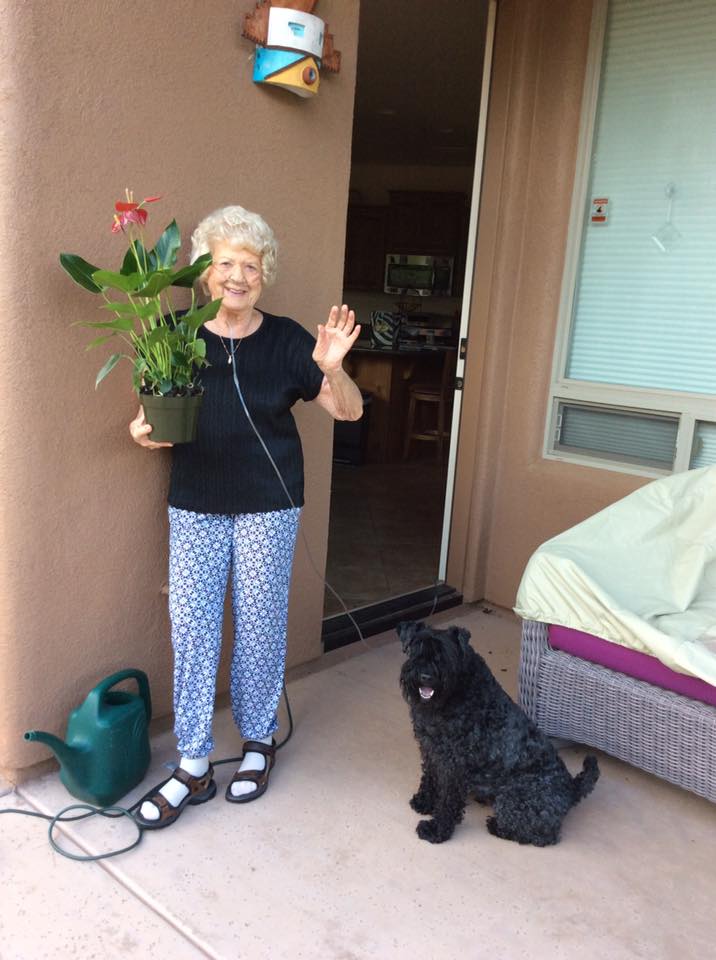
For now, because the tears are welling up again, I’ll let these photos speak as a reminder of a life well lived.
I thought you’d get a kick out of seeing some photos from Dottie’s birthday party.
We’ll start with the amazing scenery, near Sedona, Arizona:
It was a beautiful day. Big fluffy white clouds drifting aimlessly across a pretty blue sky. Arizona is nothing if not beautiful.
The real fun was at Cindy’s house. Cindy is one of Dottie’s daughters, and they live together. There were only a handful of us, and we were very mindful of the pandemic – each of us is fully vaccinated and had a negative covid test before the party. If the world were different and Dottie was allowed to invite all of her friends, I’m sure the gathering would’ve been quite the raucous affair! We had to keep it small for everyone’s safety, but particularly Dottie’s. Obviously.
Here’s the party girl herself:
If I had an image in my mind of what age 95 looks like, it wasn’t this!
Here’s a closer look at the cake, which is a photo of Dottie when she was around 30 years old (she had six kids at the time of the photo):
What a looker! And I’m not talking about the cake!
Here she is on Saturday with daughter Cindy:
I love that photo!
And with me:
I know you’re dying to know. Her shirt says, “I’m an August woman, I was born with my heart on my sleeve, a fire in my soul, and a mouth I can’t control!” Haha, it’s perfect!
We had lots of laughs, good food, and great conversations. Dottie attracts wonderful people, so it was a lovely day in honor of an amazing woman.
“Why would you want to live in the desert? It’s so brown!”
“There’s no color in the desert.”
“Nothing blooms in the summer in Phoenix – it’s too hot!”
Yeah, yeah, yeah, what a bunch of baloney! The Sonoran Desert is alive with color all summer long, despite temps that can reach above 115 degrees. All sorts of trees, shrubs and cactus have showy flowers throughout June, July and August.
That’s true of any summer in Phoenix. But this summer, the summer of 2021, we’ve had the healthiest monsoon season in years. Awesome amounts of rain all through July and so far through August as well. Shrubs that have been sparse in their flowering (for example, ones that are not on irrigation), have exploded with fresh color.
I thought those of you in other parts of the country (and world) would get a kick out of seeing what a desert city in bloom looks like, so I’ve been snapping pics for the past few weeks. Some of the cactus bloomed right before the rains first started, but the rest of the plants had the benefits of the monsoons. You’ll see flowering cactus, annuals, perennials, and shrubs in the photos below. If you have specific questions about what a certain plant is, just let me know and I’ll ID it for ya.
I hope you enjoy this photo journey of rain-happy flowers in Phoenix.
Here we are at the “look at that purple shrub!” section of the post. These fall under the umbrella of the generic term “sage,” but they’re not Salvias – these are Leucophyllums. And they have been spectacular!
The sages loooove monsoon rains. For a few weeks, everywhere you looked around the city there were pops of purple, or rows of royalty, haha! Definitely a nice addition to any landscape.
The monsoons cleared out temporarily as of last night. It’ll be interesting to see what happens when we have a few days of sunshine again. I’ll be keeping an eye out for what’s blooming and take pics whenever I can.
On an unrelated note, there is a certain one of our very own Experts, a lady of charm and distinction, with superior intelligence and unmatched compassion, known far and wide as a National Treasure, aka Dottie Correll, who is turning a whopping 95 years old on Saturday. 95! She’s doing great. If you’d like to wish her a happy birthday, please do so in the comments and I’ll happily pass them along for you.
Join 667 other subscribers
About Me
Hi! My name is Liza. Welcome to my blog and thanks for visiting! I’m a Midwestern gal now living in Arizona, after many years of living in and owning a plant care business in New Mexico.
Plants are living, breathing creatures, and if they’re indoor plants, they are 100% dependent on human care. They cannot water themselves.
Please let me know if you have questions or if you would like help with your plants or garden. You can reach me at lizatheplantlady (at) gmail (dot) com or follow me on Twitter, Lizawheeler7.
All photos are mine unless otherwise noted. All content is also entirely my hard work. If you’d like to use any content or photos, all you have to do is ask. If you take without asking, you are a thief. And thieves suck. So don’t suck. We have a deal? Good.







 Good To Grow